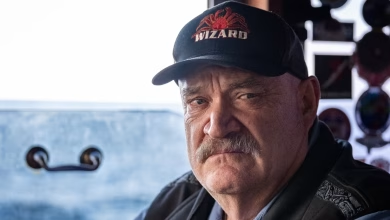
The Most Dangerous Fishing Grounds in America – Deadlier Than Any Storm
The Most Dangerous Fishing Grounds in America – Deadlier Than Any Storm

Deadlier Than the Storm: Inside America’s Most Dangerous Fishing Grounds
In the heart of the open sea, a small fishing boat sways violently, battling the fury of the ocean. Waves crash over the deck with relentless force, threatening to engulf everything — men and machines alike. For most of us, a storm at sea is the ultimate maritime nightmare. But for American fishermen, it’s just the beginning.
In some parts of the United States, the ocean holds dangers far deadlier than any hurricane. Here, it’s not just the wind and waves — it’s the ice, the terrain, the cold, and the crushing pressure of the job that make fishing one of the most perilous professions on the planet. Each voyage isn’t merely a job. It’s a gamble — a battle of survival.
Join us as we explore the deadliest fishing grounds in America — places where every catch could be your last.
1. The Gulf of Mexico: Prosperity Beneath the Storm
Beneath its turquoise surface, the Gulf of Mexico hides both riches and ruin. As the backbone of America’s deepwater shrimp fishery, the Gulf feeds thousands of families across Texas, Louisiana, and Mississippi. But behind these thriving statistics lies a hidden cost — one of the highest death rates in the industry.
Tropical storms with winds exceeding 150 mph are not rare here — they’re routine. Fishermen must race against time, hauling in their catch before the next storm hits. When skies are calm, oil rigs clutter the horizon, creating another layer of danger. One wrong move, one small navigation error, can lead to catastrophe.
And then there’s the daily grind: 16- to 18-hour shifts in sweltering heat, surrounded by the pungent stench of diesel, salt, and steam. Fatigue and disorientation set in fast. And when they do, accidents become inevitable.
In the Gulf, the sea is rich, but every voyage asks a price.
2. Columbia River Bar: The Graveyard of the Pacific
Heading northwest, we meet the Columbia River Bar — perhaps the most feared gateway to the Pacific Ocean. Known ominously as the Graveyard of the Pacific, this deadly river mouth has claimed more than 2,000 vessels over the past two centuries.
Here, the powerful Columbia River collides violently with the Pacific tide, creating towering wave walls — some reaching 50 feet high. Combine that with dense fog and rapidly shifting winds, and you get one of the most treacherous maritime passages in the world.
Despite the risks, these waters are a lifeline for Oregon and Washington’s fishing communities. Rich in salmon and Dungeness crab, they draw boats through deadly surf, time and time again. To navigate this hazard, specialized pilots and rescue teams are deployed — some of the most skilled seafarers in the country. Yet even they admit: no passage is ever truly safe.
3. The Aleutian Islands: Frozen Hell at Sea
Beyond the Pacific Northwest lie the Aleutian Islands, where the Bering Sea meets the raw fury of the Arctic. Fishermen here face a different kind of storm — one made of ice, fog, and wind.
Winter gales regularly exceed 100 mph. Visibility often drops to near zero. Worse still, everything — decks, rigging, gear — freezes over within minutes. Ice buildup can capsize a boat if not constantly chipped away. It’s a grueling task, made harder by the bitter cold and constant threat of falling overboard.
Yet, beneath these icy waves lies one of the richest fisheries in the world. Pacific cod, black cod, and king crab fill nets weighing several tons. The industry here pumps hundreds of millions of dollars into the Alaskan economy. That wealth is why, despite the dangers, generations of fishermen continue to return.
The Aleutians are not for the faint of heart. But for those who endure, the rewards are immense.
4. Grand Banks of Newfoundland: Fog, Fish, and Fatalities
On the opposite side of the country lies a legend — the Grand Banks, stretching off the coast of New England and into Canadian waters. Historically one of the richest fishing grounds on Earth, this region has fed the world for centuries.
But it comes at a steep price.
Here, the warm Gulf Stream collides with the icy Labrador Current, creating sudden storms and thick fog banks that can swallow ships whole. The sea changes color, mood, and temperament in hours — leaving fishermen vulnerable in an ever-shifting natural trap.
Their quarry? The mighty halibut — a flatfish that can grow over 6 feet long and weigh up to 440 pounds. Catching them requires lowering enormous nets to the cold seabed and hauling in literal tons of fish. In freezing winds and blinding fog, the work is back-breaking. But the payoff — in global markets and local pride — is undeniable.
5. The Bering Sea: The Real-Life Deadliest Catch
No place captures the sheer brutality of ocean fishing like the Bering Sea. Made infamous by the series Deadliest Catch, this stretch of water between Alaska and Russia is less a fishing ground and more a crucible of survival.
Crab fishing seasons are short — just a few weeks to haul in as much as possible. With thousands of dollars at stake per pot, crews work 20-hour shifts in freezing dark, howling wind, and mountainous waves. The cages — often weighing over 800 pounds — must be hauled, stacked, and sorted by hand.
The cold itself is lethal. Fall overboard, and you’ll last mere minutes before hypothermia sets in. Many deaths happen silently, with no time to scream above the roar of wind and water.
At one point, the Bering Sea crab industry had a mortality rate exceeding that of U.S. troops in combat — a shocking, brutal statistic that underlines just how real the danger is.
Yet fishermen still return. For the money, yes — but also for the pride, the heritage, and the challenge. For them, it’s not just a job. It’s a way of life. A test of will. A tradition.
More Than a Job — A Battle With Nature
From the storm-ridden Gulf of Mexico, the treacherous Columbia River Bar, and the frozen Aleutians, to the foggy Grand Banks and the brutal Bering Sea, one truth becomes evident:
Fishing in America is not just about food. It’s about survival.
These fishing grounds are battlegrounds — where human endurance meets nature’s fury head-on. Where courage, skill, and luck determine who returns home and who doesn’t.
And still, the boats go out.
Because someone has to bring the ocean’s bounty to shore.
Because for many, the sea isn’t just a source of income — it’s a calling.