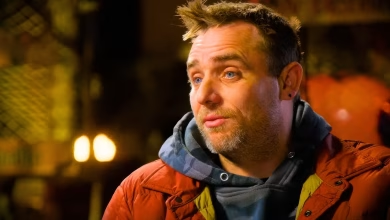
The Heartbreaking Tragedy Of Nick McGlashan (Deadliest Catch)
The Heartbreaking Tragedy Of Nick McGlashan (Deadliest Catch)

Remembering Nick McGlashan: The Heartbreaking Truth Behind a Deadliest Catch Hero
A Life Too Short, A Legacy Too Deep
Nick McGlashan wasn’t just another deckhand on Deadliest Catch—he was the heartbeat of the boat, a fearless force against the wrath of the Bering Sea, and a fan favorite for his grit, humor, and undeniable toughness. But behind that strength was a man fighting silent storms that no camera could fully capture. His sudden death in December 2020 sent shockwaves through the Deadliest Catch community and beyond. What followed was not just mourning—but reflection. Nick’s story is not only one of pain and struggle, but of strength, vulnerability, and a brutal spotlight on addiction and mental health in an industry that too often buries both.
A Shock That Stopped the Show Cold


When news broke that Nick McGlashan had died at just 33 years old, fans, friends, and fellow fishermen were left speechless. He passed away alone in a Nashville hotel room—far from the icy waters he once conquered. An autopsy revealed the cause: a toxic mix of methamphetamine, cocaine, and fentanyl. For many, it seemed unthinkable that someone who had braved the worst nature could throw at him could fall to something so invisible.
Captain Bill Wichrowski, who had worked closely with Nick, said it was a devastating loss—not just to the crew, but to the family they had become. For years, Deadliest Catch was more than a show—it was brotherhood. To lose Nick wasn’t just losing a crew member. It was like losing a limb.
Fighting Demons Behind the Deck
Nick’s battle with addiction wasn’t a tabloid secret—it was a lived reality. He had been open about his struggles and had even gone to rehab in 2017, hoping to turn his life around. And for a while, it looked like he had. He returned to the show, stronger, healthier, and more determined than ever. But addiction is a lifelong enemy, and Nick’s environment didn’t offer rest.
The life of a commercial fisherman is already brutal: long weeks at sea, freezing temperatures, physical exhaustion, and emotional isolation. Add to that the pressure of reality TV—constant cameras, the expectations of fans, and the pressure to perform—and you have a powder keg. For Nick, every pot hauled, every crab caught, was another moment hiding the mental battle he was silently waging.
More Than a Reality Star
What made Nick special wasn’t just his resilience on deck—it was his ability to stay real. Unlike many reality TV figures who seem to play roles, Nick was unapologetically himself. He spoke candidly about addiction. He didn’t pretend to be perfect. He wore his past like a badge—not of shame, but of survival.
Nick grew up in Alaska’s rugged landscape and was raised in the fishing world. To him, Deadliest Catch was more than television—it was a platform to show the world what his people endured. His charisma, sense of humor, and raw energy made him an icon. But as his popularity grew, so did the pressure to keep it all together. He had to fight his addiction while being held up as a role model—a contradiction too heavy to carry forever.
The Weight of Silence
One of the most painful lessons from Nick’s story is that even the strongest among us can crumble if we don’t get the help we need. And in Nick’s world, asking for help was rarely an option. The culture of fishing—like so many male-dominated, high-risk jobs—often glorifies silence. You push through. You endure. You keep going. Vulnerability isn’t respected. But it should be.
Nick was one of the few who broke that code. He admitted he needed help. He went to rehab. He spoke out. But like many who battle addiction, relapse found him. And the silence returned—until it was too late.
More Than a Deckhand: A Symbol of Strength and Struggle
Nick’s journey on Deadliest Catch was remarkable. He rose through the ranks not just because he was good at what he did—but because he had heart. He cared deeply for his crew, his craft, and the life he represented. Fans didn’t just admire him—they felt connected to him. They saw someone who wasn’t pretending to be tough—he was tough. But they also saw someone with pain behind the eyes.
And that’s what makes his story resonate. He was real. And like so many people today, he was trying to be strong while quietly drowning.
A Wake-Up Call for the Industry—and All of Us
Nick’s death triggered conversations that were long overdue—not just about addiction, but about the price of entertainment. Reality TV often glamorizes struggle without showing the toll it takes. In a world where trauma becomes ratings and breakdowns become moments of drama, we forget that these aren’t just “characters.” They’re people.
Nick’s story should be a turning point—not just for Deadliest Catch, but for all reality programming. We need to ask: What happens when the cameras stop? Who is checking on the people we watch suffer for our entertainment? And what does it say about us when we cheer for resilience but ignore the pain?
Legacy Beyond the Waves
Since his death, Nick has been remembered with honor on Deadliest Catch—through tributes, memorial episodes, and the quiet moments his crew still leaves for him. But his true legacy is not just in the episodes he appeared in. It’s in the conversations he started, the awareness he raised, and the countless people he encouraged to seek help.
Nick McGlashan’s story isn’t just tragic—it’s instructive. It teaches us that real strength isn’t hiding your pain. It’s being willing to face it. His courage to speak out, to fight back, to live truthfully, even when it was messy, is what made him truly heroic.
Conclusion: Behind Every Storm Is a Story
Nick McGlashan lived a life most of us could never imagine. He conquered the Bering Sea, made us laugh, made us cry, and reminded us that behind every fearless deckhand is a human being carrying more than crab pots.
His story is one we cannot forget.
So the next time you watch Deadliest Catch, remember: you’re not just watching fishermen—you’re witnessing people fighting real battles. Some on deck. Some deep inside. And all of them matter.